Essential means something specific
In nutrition, an essential nutrient is one an animal cannot make in sufficient quantity and must therefore obtain from diet. It is a technical term, not an emphasis.
Dogs can synthesise taurine from other sulphur-containing amino acids. Cats largely cannot — the enzymatic machinery is limited — and on top of that, cats lose taurine continuously, because they can only conjugate their bile acids with taurine, while other species can substitute glycine. Low production, obligatory loss.
The consequence is that dietary taurine is not optional for a cat. It is a requirement.
What the deficiency story taught the industry
This is settled science, and it arrived the hard way.
In the 1970s and 80s, cats fed commercial diets began presenting with two serious conditions: central retinal degeneration, causing progressive vision loss, and dilated cardiomyopathy, a form of heart failure. Both were eventually traced to taurine deficiency. Reformulating commercial cat food with adequate taurine caused the incidence of both to collapse.
That episode is why taurine requirements are now written into pet food standards, and why any complete commercial cat food should already supply it. It is also a permanent lesson about extrapolating between species: the diets involved were not obviously deficient, they were deficient for cats.
If your cat eats a complete, balanced commercial diet, taurine is already provided. Supplemental taurine is not a treatment for heart or eye disease — those are veterinary diagnoses. Talk to your vet before adding taurine if your cat has a known cardiac condition.
Why cats need their own formula
Taurine is the clearest example of feline difference, not the only one.
- Obligate carnivore metabolism. Cats are adapted to a meat diet and have limited ability to convert certain plant-derived precursors into the forms they need.
- Different clearance rates. Cats process and eliminate many compounds differently from dogs, so a dose is not a matter of scaling by body weight.
- Specific sensitivities. Some compounds that are unremarkable for dogs require care in cats. Copper is a well-known example in the context of feline hepatic health, which is why a considered cat formula thinks about copper content rather than inheriting it from a dog recipe.
- Palatability is a hard constraint. A cat that refuses a supplement receives zero of it. This is not a minor detail — it is a formulation requirement.
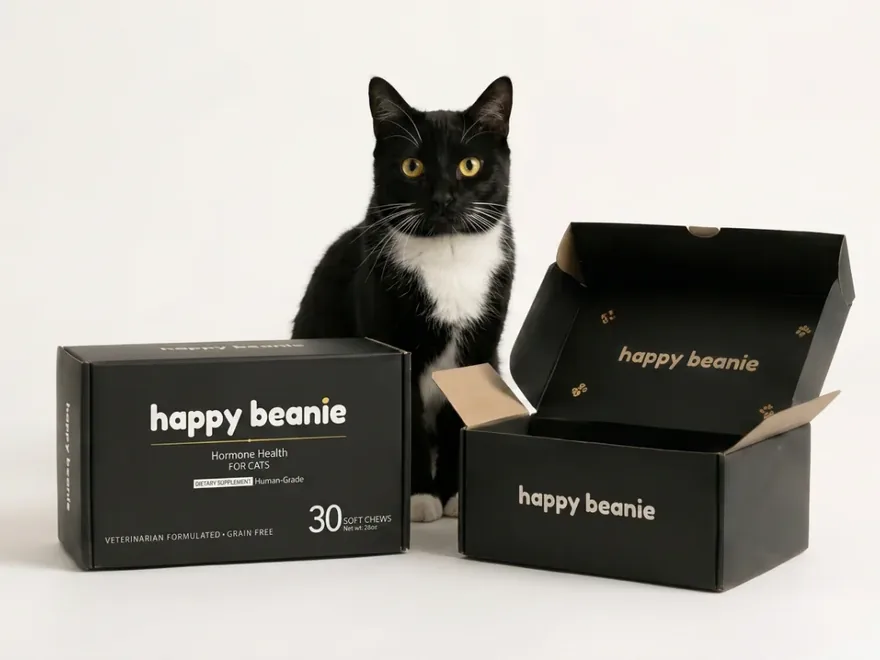
Taken together, these are why our cat formula is reformulated rather than portioned down: a peptide blend dosed for feline clearance, a taurine and salmon base, and green-lipped mussel — instead of the elk and mushroom blends in the dog formula.
What green-lipped mussel brings
Perna canaliculus is a mussel native to New Zealand, farmed there at scale and used in joint supplements for both dogs and cats. It is a whole-food source of several things at once:
- Glucosamine and chondroitin, naturally present rather than added as isolates.
- Omega-3 fatty acids, including some unusual ones — eicosatetraenoic acid (ETA) is relatively rare in the food supply and is part of why the ingredient attracts research interest.
- Minerals and amino acids in the proportions of whole shellfish.
The research base includes work in dogs and, less extensively, in cats, generally examining joint comfort and mobility. As with velvet antler, the studies tend to be small and short — a real signal, not a settled conclusion. The framework for weighing that sits in how ingredients are studied.
Processing matters here more than most ingredients: those omega-3s are heat sensitive, so how the mussel is dried determines how much survives. Cold-processed or freeze-dried material is preferable to heat-dried, and it is a fair question to ask a manufacturer.
Salmon oil, and why palatability is formulation
Salmon oil does two jobs in a cat formula. It supplies EPA and DHA, the long-chain omega-3s that cats — being poor converters of plant-derived ALA — are better off receiving directly. And it makes the product taste like something a cat will actually eat.
The second job is not a marketing consideration. Compliance is the difference between a formula that works and a formula that sits in a cupboard, and cats are famously unwilling to be persuaded. A cat supplement that has not solved palatability has not solved anything.
Before you add anything to a cat's diet
- Check what the current food already provides. A complete diet supplies taurine; more is not automatically better.
- Ask your vet if there is any cardiac or ocular history. Those are the two systems with a documented taurine connection, and they are veterinary territory.
- Screen the whole ingredient list against your cat's medications and conditions, not just the headline ingredient. Our eligibility screener does this in about a minute.
- Introduce one new thing at a time. With a cat you are testing acceptance as much as effect.
Frequently asked
Generally no. Complete and balanced commercial cat foods are formulated to meet established taurine requirements, precisely because of the deficiency problems identified decades ago. Cats on homemade, raw or unconventional diets are a different matter and should be discussed with a veterinarian or a veterinary nutritionist.
It is not a good idea. Cats have different essential nutrients, different clearance rates and specific sensitivities, so a dog formula is not simply a stronger version of a cat one. Use a product formulated for the species in front of you.
It is shellfish, so an animal with a known sensitivity should avoid it. True food allergies in cats are less common than owners assume — chicken, fish and beef are the more frequent culprits — but if your cat has a diagnosed sensitivity, check the full ingredient list with your vet.
Taurine is water soluble and excess is generally excreted, so it has a wide margin of safety and toxicity is not a common concern. That is not a reason to add it casually: if your cat has a cardiac diagnosis, dosing is a decision for your veterinarian, not a supplement label.
Not sure it is right for your pet?
Our eligibility screener checks your animal's medications and conditions against every ingredient on the formulation sheet. One minute, eight questions, and it will tell you if we are not a fit.