Why cats are a different problem
Most "anti-aging pet supplements" are dog products with a cat on the box. That is a problem for two reasons.
First, cats are obligate carnivores with their own biochemistry. The clearest example is taurine: a dog can make enough of it, a cat cannot, and a cat without it develops heart failure and goes blind. A formula that ignores that is not a cat formula.
Second, cats hide pain. A dog with sore hips limps; a cat with sore hips stops jumping onto the counter and sleeps a little more, and most owners read that as "she's just getting old". Studies of older cats find joint changes on X-ray are common, and the owners of those cats mostly had not noticed. Any honest account of anti-aging in cats starts from the fact that you will not see the problem coming.
What changes as a cat gets older
- Joints and connective tissue. Degenerative joint disease is far more common in older cats than its low profile suggests, and it shows up as behaviour, not limping.
- Heart muscle. The feline heart depends on taurine and on the cell's energy machinery; both are worth protecting for the whole of adult life.
- Lean mass. Older cats lose muscle along the spine and hindquarters, which is what a "bony" senior cat is.
- Urinary tract. Not ageing exactly, but the most common reason an indoor cat sees a vet, and worth a place in a daily formula.
- Energy and engagement. Less play, fewer greetings at the door. Some of that is age; some of it is discomfort.
Ingredients with trials in cats
Feline trials are rarer than canine ones, which makes the ones that exist more valuable. Three ingredient classes have work in cats that we think is worth your time. We link to every paper, and none of them was funded by us.
Taurine. In 1987 Science published Pion and colleagues' controlled feeding trial: cats in heart failure from low taurine recovered normal heart function once taurine was restored. The damage reversed, and taurine became mandatory in cat food. It is the single best-proven nutrient in feline medicine, and the reason it leads our cat formula. More in why cats need taurine. The paper.
Green-lipped mussel with omega-3s. A randomised, controlled, masked trial by Lascelles and colleagues in the Journal of Veterinary Internal Medicine (2010) fed cats with degenerative joint disease a diet built on green-lipped mussel and omega-3 fatty acids. The cats were measurably more active than cats on the control diet — tracked by an activity monitor rather than owner opinion, which in cats is the only way to know. The paper.
Undenatured type II collagen. A clinical trial in cats with degenerative joint disease reported improved mobility and daily activity on undenatured type II collagen, confirming that the collagen-peptide mechanism works in cats and not only in dogs. This is the signalling layer — instructions to rebuild rather than raw material — and the reason a peptide sits alongside the whole-food ingredients. The trial.
To be explicit: published research on an ingredient is not a claim about any finished product containing it, including ours. None of these papers tested our chew. They are the reason each ingredient is in it.
Ingredients with a rationale but thinner evidence
- Omega-3 EPA and DHA from salmon oil have broad support across species and were part of the Lascelles diet above. Well grounded; watch dose and freshness.
- Cranberry extract is traditionally used for urinary support. The mechanism — making it harder for bacteria to adhere — is real in the laboratory; the trial evidence in cats is limited, and it is no substitute for water intake and a vet when a cat strains.
- CoQ10 (ubiquinol) and L-carnitine sit in the energy machinery of muscle, including heart muscle. The rationale for an older cat is direct; the feline trial evidence is modest.
- Blueberry polyphenols and the B-complex vitamins have mostly mechanistic and cross-species support. Sensible to include, not something to headline.
For the framework — cell culture, then rodents, then the target species, then controlled trials in it — see how pet supplement ingredients are studied. The dog evidence is a separate article: anti-aging supplements for dogs.
How to judge a cat supplement
- Built for cats, not relabelled. Taurine on the panel is the quickest tell. So is the absence of ingredients that suit dogs and not cats.
- Amounts per serving, not a proprietary blend. Otherwise you cannot compare what you are buying to what was trialled.
- A form a cat will actually take. The best formula on paper is worth nothing in the bin under the bowl. Soft chews given after a meal have the best odds.
- A certificate of analysis for the lot you hold. Identity, potency, heavy metals, microbes. How to read one.
- Claims that describe support, not treatment. "Supports mobility" is appropriate. "Reverses ageing" is a flag.
The full nine-point version is in what makes a high-quality pet supplement.
Where Happy Beanie sits
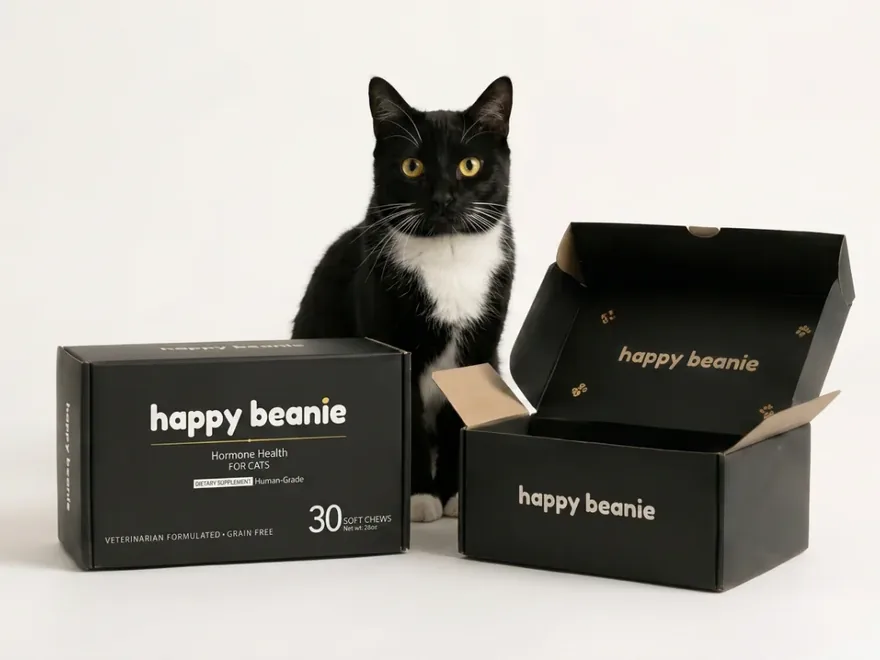
Our cat formula is its own formulation, not the dog chew resized. It carries the three ingredient classes above — taurine, green-lipped mussel with salmon-oil omega-3s, and a collagen peptide — alongside organic cranberry extract, blueberry polyphenols, CoQ10, L-carnitine and a B-complex. One soft chew a day at any weight, and every lot third-party tested with the certificate published.
The feline studies are stacked on the product page with a link to each paper, and the lab results are in the certificate library. If you are not sure it is right for your cat, the screener will tell you plainly.
Frequently asked
Indoor cats live longer, which means more years of the slow changes described here, not fewer. Whether any individual cat needs one is a question for you and your veterinarian; what we can say is that the ingredients with feline trials behind them were studied in ordinary house cats.
No. Cats are obligate carnivores with different requirements — taurine is the clearest example — and some ingredients that suit a dog do not suit a cat. Use a formula built for cats and screen it against your cat's medications and conditions.
Watch the things cats hide: jumping onto the counter without pausing, using the top of the scratching post again, grooming the hard-to-reach patches. The feline trials measured activity by device for exactly this reason — owners are poor witnesses of their cat's pain.
Yes. A supplement is not a treatment for kidney disease, heart disease, arthritis or anything else with a diagnosis. If your cat is on medication, pregnant, or has a diagnosed condition, ask your veterinarian before adding anything.
Not sure it is right for your cat?
Our eligibility screener checks your cat's medications and conditions against every ingredient on the formulation sheet. One minute, eight questions, and it will tell you if we are not a fit.